What Is Holding Up Your Outdoor Unit?
When choosing an air-conditioning system, considerable attention is given to the brand, capacity, efficiency, features and price.
Far less attention is usually given to the two brackets holding the outdoor unit to the wall.
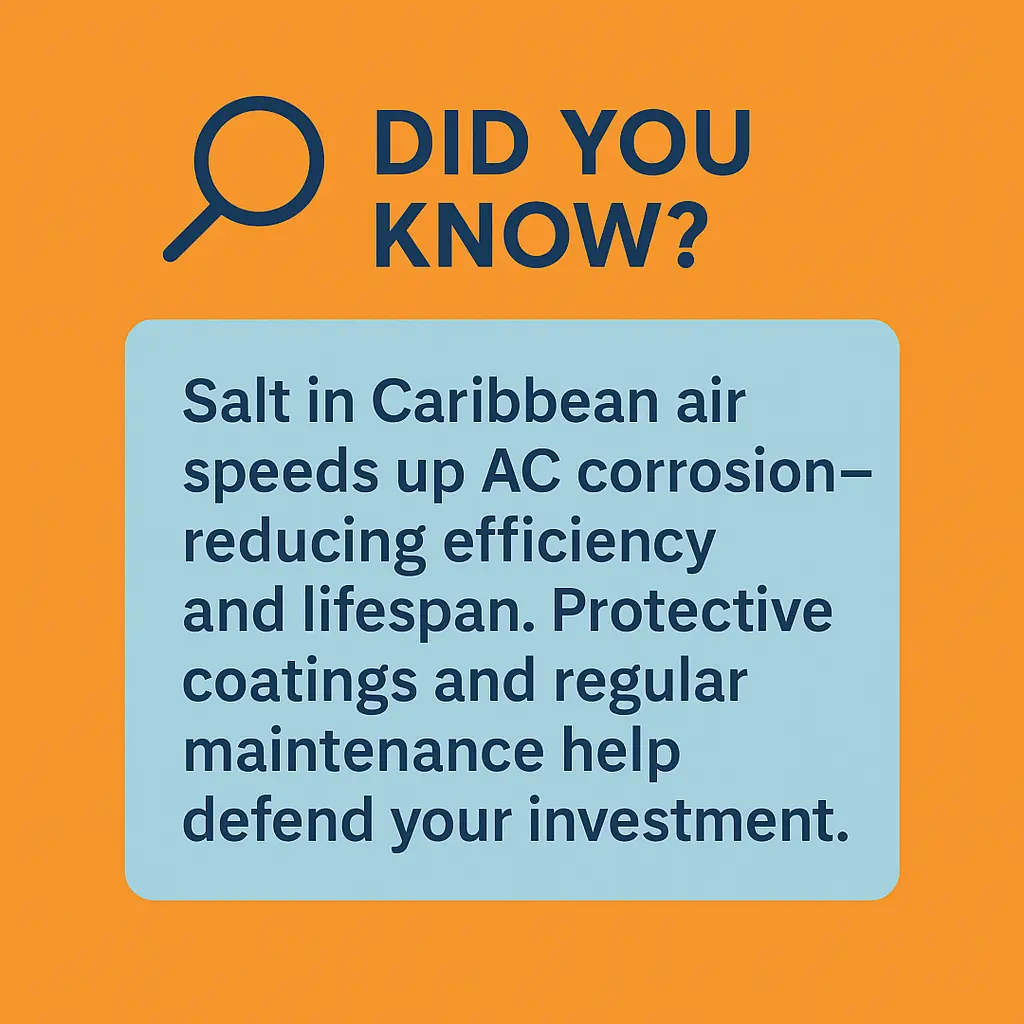
Yet those brackets may spend years supporting a valuable piece of equipment while exposed to rain, humidity, salt-laden air and the wider conditions of a Caribbean environment.
The bracket may be a small part of an HVAC installation, but its job certainly isn't.
The Environment Matters
Outdoor AC brackets are commonly manufactured from coated steel or stainless steel. Both can provide reliable support when properly selected, installed and maintained, but they respond differently to environmental exposure.
Painted or coated steel relies heavily on its protective coating to separate the underlying metal from moisture and contaminants. When that coating remains intact, the bracket can perform reliably for years.
Scratches, damaged edges, installation holes and deterioration of the coating can eventually expose the steel underneath. Once corrosion begins, it can progressively affect both the appearance and integrity of the bracket.
Stainless steel provides corrosion resistance through the composition of the metal itself. Chromium within the alloy forms a thin protective layer at the surface, giving stainless steel its familiar resistance to rust and corrosion.
That makes stainless steel an attractive option for outdoor HVAC installations, but there is an important detail.
Not All Stainless Steel Is the Same
"Stainless steel" describes a family of alloys rather than one universal material.
Grades such as 201, 304 and 316 have different compositions and levels of corrosion resistance. The appropriate choice depends partly on the environment in which the bracket will spend its life.
This becomes particularly important in the Caribbean.
Salt-laden coastal air can be aggressive toward metals. Even stainless steel can develop staining, pitting or corrosion under sufficiently severe chloride exposure. Higher grades such as 316 are generally preferred where resistance to marine environments is a major design consideration.
The useful question, therefore, isn't simply, "Is it stainless steel?" It is also:
"Which grade is it, and where will it be installed?"
Coated Steel or Stainless Steel?
There is no single answer for every installation. A quality coated-steel bracket may provide good service in a relatively sheltered environment, particularly when its protective finish remains intact and the bracket is inspected as part of routine maintenance.
Stainless steel provides another option where greater inherent corrosion resistance is desirable and reduces dependence on a surface coating for protection.
The decision should consider:
- Distance and exposure to the coastline
- Rain and prevailing weather conditions
- Equipment size and weight
- Bracket load capacity
- Accessibility for inspection and maintenance
- Expected service life
Material is therefore only one part of choosing the right bracket.
The Rest of the Mounting System Matters Too
A stainless-steel bracket does not automatically create a corrosion-resistant installation. Anchors, bolts, washers and other fasteners are part of the same support system. Their material compatibility and suitability for the installation environment also matter.
The wall or structure must be capable of supporting the equipment, the correct anchors must be used, and the bracket must be appropriately sized for the outdoor unit. Good equipment deserves a good foundation.
Clim8 offers 201 stainless-steel mini-split mounting brackets, with sizes available for 9,000–36,000 BTU systems.
201 stainless steel provides useful corrosion resistance and an alternative to conventional coated-steel brackets. As with any mounting material, suitability should be considered against the conditions at the installation location, particularly in areas with significant marine exposure.
For more aggressive coastal environments, the appropriate solution may involve a different stainless grade, mounting arrangement or corrosion-protection strategy.
An HVAC installation is a collection of components working together. Refrigerant piping, electrical protection, drainage, mounting hardware and equipment supports all influence how reliably the finished system performs over time.
The bracket may be one of the least noticed components of an air-conditioning installation. Considering what it is being trusted to support, perhaps it deserves a little more attention.