Do HVAC Systems Really Run at Full Capacity?
In the Caribbean, cooling is needed year-round. That reality often leads building owners and decision-makers to assume their air-conditioning systems operate near full capacity most of the time.
They don’t.
Full-load vs Part-Load Cooling
Full cooling demand occurs only when several factors align at once: high outdoor temperatures, strong solar gain, near-maximum occupancy, and sustained equipment operation. Those conditions occur, but they represent a relatively small portion of the year. Even in warm climates, commercial buildings operate below peak demand for most of the year. Offices empty and refill. Meeting rooms cycle. Hotels fluctuate. Internal heat gains rise and fall throughout the day. When cooling demand is modeled hour by hour across an entire year, the same pattern appears consistently: most buildings operate at 30–70% of their design cooling load for the majority of the time.
Part-load describes conditions where only a portion of the installed cooling capacity is needed. Morning hours, partial occupancy, cloudy days, shaded facades, and mixed-use spaces all contribute to these conditions. For most commercial buildings, part-load operation represents normal behavior rather than an exception.
Peak load exists to be handled reliably, but it does not define daily operation. Systems such as Variable Refrigerant Flow (VRF) systems are designed to perform efficiently during part-load conditions.
Why Annual Energy Use Is Hour-Based
Energy consumption accumulates over time. At its simplest, annual energy use is determined by:
Power drawn × hours of operation
Peak performance still matters. It ensures a system can meet demand during extreme conditions and affects equipment sizing and capacity adequacy. However, annual energy bills are shaped far more by how systems perform during the thousands of hours when demand is moderate. Performance during these hours has a greater influence on yearly energy consumption than performance during a relatively small number of peak events.
This is why modern efficiency standards place significant emphasis on part-load performance. They reflect how buildings actually operate.
The Impact of Improper Sizing
Over sizing is common, often driven by caution or habit. Under sizing presents its own risks during periods of high demand.
In practice, systems that are not aligned with realistic load behavior tend to:
- Cycle frequently instead of operating steadily
- Run inefficiently for most of their operating hours
- Experience higher mechanical stress
- Deliver inconsistent comfort
- Consume more energy over time
These effects develop gradually and are often misattributed to equipment age rather than system design decisions.
Effective HVAC design accounts for both peak conditions and everyday operation. Systems must meet demand reliably during extreme periods while operating efficiently during normal conditions.
Because buildings operate below peak load for most of their lives, the characteristics that influence part-load performance play a significant role in long-term outcomes.
Energy use, equipment lifespan, maintenance demands, and operating stability are all shaped by how well a system performs during these everyday conditions.
Cooling Load Duration Curve
The majority of HVAC operating hours occur at part-load conditions. The curve below illustrates how rarely systems operate near full capacity.
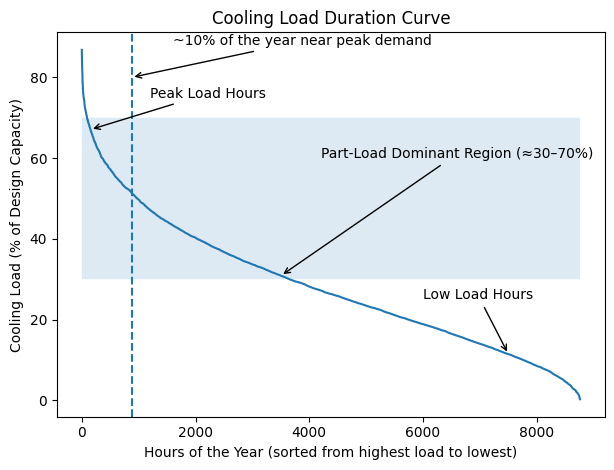
When cooling demand is arranged from highest to lowest across the year, it becomes clear that full-load conditions occur for only a small number of hours. Most commercial buildings operate at part-load for the majority of the year, which is why system sizing and part-load performance strongly influence annual energy consumption.